
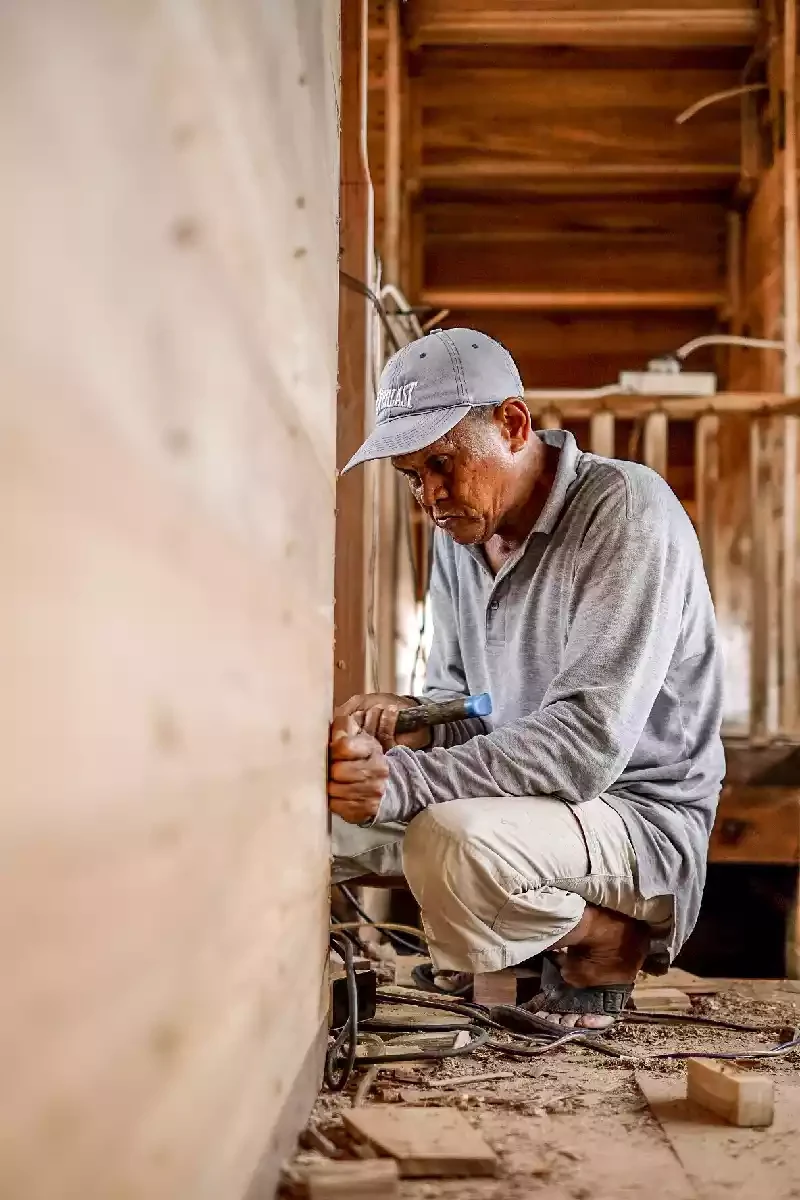
Tana Beru Boat Builder FAQ
This hub answers 100 real questions on commissioning a wooden phinisi or gulet in Tana Beru — cost bands, timber, shell-first construction, liveaboards, gulets, design, timber legality, owner supervision and handover — all in one place.
100 Questions, Answered
Yes. Most of our owners are international and run the build remotely through milestone photos, video and occasional site visits.
Send the intended length, how you will use the boat, and a rough budget band on WhatsApp, and we return a realistic outline.
We build to order only. A keel is laid specifically for your vessel.
Yes. You are welcome to visit Tana Beru, see boats under construction and meet the build team before any commitment.
Because builds run 8–24 months and yards book ahead, planning 6–18 months before you need the boat is sensible.
No. Exploring a build and receiving an outline layout, band and timeline costs nothing.
Yes, provided the ownership and contract structure is agreed at the outset. We will document it clearly.
Length, intended use and route, cabin count, whether it is private or charter, and your budget band.
The bottom of the first band — roughly USD 180k — for a simple, well-built ~20 m owner phinisi.
USD is the planning currency our international owners use; government fees are quoted separately in local currency where required.
No. They are honest planning bands. A firm figure is set once your specification is locked.
In stages tied to build milestones and released against completed, evidenced work — not the calendar.
Owner-supplied electronics or tenders beyond the agreed package, delivery voyage or shipping beyond Sulawesi, and government fees and duties.
We work to a band and show where your brief lands inside it, then adjust spec to fit the ceiling before you commit.
Almost always — each extra metre adds structure, systems and interior. Length is the biggest single cost lever.
Significantly. An ironwood-heavy structural spec costs and weighs more than a bitti-and-bengkirai build.
We do not provide financing; the staged milestone schedule spreads payment across the build period.
For the right boat on the right route, managed charter can offset ownership, though returns are never guaranteed.
There is no single best — ironwood for strength, bitti for planking and framing, teak for decks and joinery, matched by role.
Ulin is ironwood (kayu besi), an extremely dense, rot-resistant hardwood ideal for keel and structure but heavy and increasingly regulated.
Bitti (Vitex cofassus) is a local shipwright favourite prized for planking and framing.
Teak earns its place mainly in decks and joinery; the structural hull often uses ironwood and bitti.
Bengkirai (yellow balau) is a sound, cost-aware hardwood suitable for parts of the hull.
Yes — we source SVLK-verified legal timber and document it, which also matters for export and classification.
Yes. We match timber to role and explain the trade-offs of weight, longevity, cost and legality before you decide.
With honest maintenance — regular caulking and antifouling — a well-built hardwood hull lasts decades.
Planks are shaped and fastened into a self-supporting hull first, and frames are fitted into that shell afterwards.
Peg fastening draws seams tight, suits tropical hardwood, and makes the hull repairable plank by plank.
Yes — galvanised bolts and drift fasteners are added where structure and load demand, alongside the wooden pegs.
The master shipwright reads the curve of each plank by eye and adjusts the next to keep the hull fair.
On the open-air beach hardstand at Tana Beru, Bonto Bahari, Bulukumba, South Sulawesi — not in an enclosed shed.
Seams are caulked and sealed for tropical service, then primed — often with iron-oxide red-lead — and finish-coated.
Yes — engines, generators, stabilisation, watermakers, electronics and classed safety gear all fit a traditional hull.
Iron-oxide red-lead primer, a traditional protective undercoat you see on hulls along the beach.
A family of two-masted Indonesian wooden vessels that evolved on the South Sulawesi coast, historically for trade and now for cruising and charter.
Most modern phinisi are motor-sailers — they set sail in the trade winds and motor through the calms.
From four to six on a 20–25 m owner boat up to ten or more on a 40 m+ liveaboard.
It depends on use: 20–25 m for private ownership, 28–35 m for charter-grade, 40 m+ for flagship liveaboards.
A properly built and equipped phinisi is a capable sea boat; range and systems are specified for your intended waters.
They are cruising vessels, not racers — comfortable passage speeds under sail and engine, prioritising sea-kindliness.
Yes — engineered for the eastern routes with dive deck, compressor space, tankage, stabilisation and comfort.
Moderate draft for the anchorages, generous range and tankage, a safe dive operation, and real comfort at anchor.
Commonly 10–20 guests depending on length and cabin layout, plus crew.
Yes, when the base hull is sound — conversion can be faster and suit a particular budget.
Commercial charter liveaboards usually do; we document the build for classification from the keel.
A moderate draft with good ground tackle suits the shallow, current-swept anchorages of the eastern routes.
Yes — wooden gulets built in the Sulawesi tradition, from plans and design through to launch.
A broad-beamed two-masted wooden motor-sailer, comfortable for relaxed cruising with generous cabins.
A gulet is broader and built around comfortable cruising; a phinisi is the taller-rigged Indonesian trading lineage.
Yes, or we develop lines and a general arrangement from your brief.
Yes — traditional lines with modern interiors, 3D layouts and buildable specifications.
That is our core approach: traditional exterior lines, modern interior, systems and comfort.
Yes — we build to your plans, collaborate with your designer, or design from your brief.
We can provide drawn lines and a 3D hull-and-interior model so you sign off before timber is cut.
Through milestone photos and video, scheduled updates, and site visits whenever you wish; we represent you on the beach.
Keel-laying, planking, framing, engineering, interior, finishing, sea-trial and launch — each a payment and photo point.
Yes, and we encourage it — an independent pre-delivery marine survey working for you, before you accept the boat.
The vessel afloat, its full build record, and the documentation it needs for its intended use and flag.
PT Komodo Galangan Nusantara, the construction entity that issues your contract.
Warranty terms are set in your build contract; talk to the Build Desk about the specifics for your vessel.
Yes — we build with export in mind and prepare the timber-legality and export documentation required.
Timber-legality evidence, ownership and build documentation, and the relevant customs and export papers, which we help prepare.
No — Indonesian government fees and duties are quoted separately and, where required, in local currency.
Depending on use and classification, international flagging is possible; we document the build to support it.
Panrita lopi — Bugis master shipwrights — and their teams, who carry the craft as inherited knowledge.
A keel-laying ritual with offerings and blessings, reflecting the belief that a boat has a life of its own.
It is the best-known phinisi boatbuilding village in Indonesia, where large hulls are still built by hand on the beach.
The traditional hull is built from inherited judgement; modern builds add drawings and engineering where needed.
Yes, through beach apprenticeship — which depends on there being genuine boats to build.
The finished hull is rolled on logs down the sand and pushed into the sea by the community.
Fly to Makassar (Sultan Hasanuddin), then travel south by road to Bulukumba and Bonto Bahari; we can advise on logistics.
There is accommodation in and around Bira and Bulukumba; we help plan visits around build milestones.
A delivery voyage or shipping can be arranged separately from the build; it is not included in the price bands.
English and Indonesian. The Build Desk corresponds comfortably in both.
We aim to reply within one to two working days during Indonesian business hours.
It needs honest, scheduled care — caulking, antifouling and timber upkeep — but rewards it with decades of service.
A settling-in check, antifouling on schedule, seam and fastening inspection and finish care; we provide a first-year checklist.
Haul-out and refit are a separate service; the Tana Beru coast has yards equipped for it after handover.
We can point you to the right group entities for management, refit or brokerage — each a separate contract.
Typically once or twice a year depending on waters and use; your maintenance plan sets the schedule.
A well-built, well-maintained traditional phinisi with clean paperwork holds value well, though no resale figure is ever guaranteed.
Yes — naming and registration are part of handover; we prepare the documentation your registry needs.
Traditional wooden craft smaller than a phinisi are built on this coast, though a full phinisi rarely makes sense below ~18 m.
Yes — with the generator and tankage capacity specified for it, full air-conditioning is standard on liveaboards.
Reliable marine diesels sized to the hull and route, with generators for hotel load; the exact package is specified with you.
Yes, though we advise honestly on how much a full rig will be used on your route versus a motor-sailer.
A 28–35 m charter-grade phinisi typically sits in the USD 380k–750k band, depending on systems and interior.
A 40 m+ flagship liveaboard typically sits in the USD 850k–2.2M band.
The staged schedule begins at an early milestone; the exact split is set in your contract.
Minor changes within reason and cost; structural changes are far easier agreed before planking begins.
Milestone-based contracts allow for discussion; talk to us early and we will work out an honest path.
Our craft is traditional wooden monohulls — phinisi and gulets. Steel and multihull work is outside our lane.
Yes — we can draw on traditional proportions and detailing to echo a particular style within a sound modern build.
Yes — stabilisation for comfort at anchor and underway can be specified, particularly on liveaboards.
Generous diesel and freshwater capacity plus a watermaker, sized to the long eastern routes; specified to your operation.
Yes — dive compressor, nitrox and a rinse-and-camera area are common in the aft third of a dive liveaboard.
Crewing and operation are outside the build contract; we can point you to the right group entities.
Tender size and davits are part of the deck design; larger dive tenders shape the aft deck layout.
Where the operation demands it, international class is achievable when the build is documented from the keel.
For the genuine panrita lopi craft, the living apprenticeship, and honest build access — not an imitation of the style.
Send your length and fit-out level to the Build Desk and we return a realistic stage-by-stage timeline.
Continue Your Build Journey
Start a Build Conversation
Every commission begins with a short, honest conversation about length, use, timber, budget band and realistic timeline — no obligation, no pressure. Contracts are issued by PT Komodo Galangan Nusantara.
+62 811-3941-4563 bd@juaraholding.com